

Short answer
Het brein combineert meerdere aanwijzingen om de wereld in 3D waar te nemen. Voor sommige van deze aanwijzingen heb je twee ogen nodig, maar niet voor allemaal! En ja, daarom kun je ook met één oog nog diepte zien.
Longer answer
Seeing with two eyes
Everything we see begins as a flat, two-dimensional (2D) image on the retina of each eye. Yet we experience the world as three-dimensional (3D). How is that possible? The answer lies in your brain. It combines the images from both eyes (each looking from a slightly different angle) and derives depth from these two images. But the brain does more than just process incoming information: it actively fills in and predicts what you are likely to see. Our perception is therefore a combination of what images actually fall on the retinas and what the brain expects to see based on experience. Your brain is, in other words, a prediction machine (you can read more about this at the BrainHelpDesk question “How is it possible that we can hear either ‘green needle’ or ‘brainstorm’ whilst the audio fragment remains the same?””‘). When you look with two eyes, the images do not coincide exactly, and our brains can make good use of this information! For objects that are not located exactly at the point you are looking at, there is a small difference in the projection onto your left and right eyes. Your brain uses this difference – binocular disparity – to estimate depth. This is called stereoscopic vision.
Seeing depth with one eye
Interestingly, about 10–15% of people have little to no stereoscopic vision. This can have various causes, for example, a ‘lazy eye’, which prevents the eyes from working together properly. You can measure this by showing people images that can only be seen with good stereoscopic vision. The most standard method is the ‘fly test’ (e.g. https://www.stereooptical.com/products/stereotests-color-tests/original-stereo-fly/).
Don’t worry! People without stereoscopic vision function perfectly well in daily life. Many people often don’t even know that they lack stereoscopic vision. This shows that although stereoscopic vision is sometimes useful, it is certainly not necessary for survival. After all, you can still perceive depth perfectly well with one eye closed. Just try closing one eye and walking around. You will notice that you can still walk without bumping into everything. That is because your brain also uses other information, such as the perspective of lines, the size of familiar objects, shadows, texture, and how objects move relative to each other when you move (motion parallax). These monocular (from one eye) cues often provide enough information to experience the world as 3D.
Brain regions
The first nerve cells in the information flow from the eyes to the brain sensitive to binocular disparity (reminder: the difference in the image on your left and right eyes) are found in the first parts of the cerebral cortex where information enters: the primary visual cortex (though not yet in layer 4 of the cortex where information first enters). These disparity-sensitive nerve cells are also found in other areas that respond to visual information. Stimulation experiments have shown that the experience of stereoscopic vision changes when these areas are electrically stimulated. Depth perception is therefore not located in a single brain area, but occurs distributed across various cortical regions.

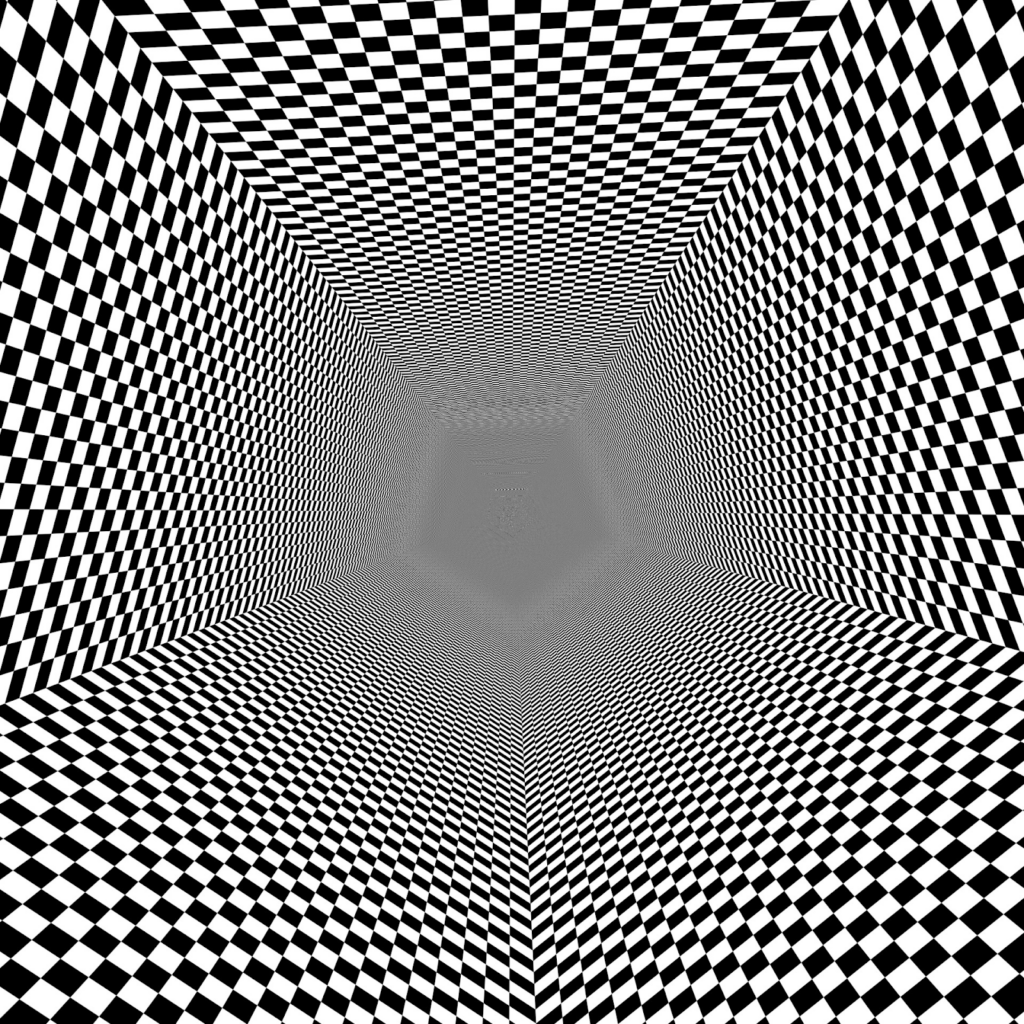
Figure 1:Two images of a well. (Left) In the real world, you can better estimate the depth of a real water well in 3D using stereoscopic vision (two eyes), but a good estimate of the depth is already possible in this photo. Source: https://commons.wikimedia.org/wiki/File:Toberbreedia_Well_02.jpg (Right) This ‘well’ is actually a visual illusion and shows how clever use of contours can ‘trick’ your brain by suggesting depth on a 2D plane, when it is physically not there. This perceived ‘depth’ can be experienced with either one eye or two eyes. Source: https://www.publicdomainpictures.net/fr/view-image.php?image=48286&picture=profondeur

Different interpretations
There is no one correct way in which the brain ‘computes’ the 3D world. An infinite number of spatial interpretations are possible from the flat image on your retina. Your brain usually chooses the most likely one, based on experience and context – which is why a photo or statue can sometimes appear deeper or flatter than you expect. So everyone sees a different 3D world.