

Short answer
No. Although our brain processes pain, touch and sensory inputs, any sensation that seems to “come from” a particular brain area is produced by how the brain interprets signals, not by activity you can consciously feel in that region. The brain itself does not have receptors for either pain or touch. Only the meninges (the membranes that cover our brain) can produce localized feelings of a headache.
Longer answer
The brain contains billions of neurons (cells that transmit signals; see also our previous answer to: ‘How is a neuron made?‘) and processes an enormous amount of information from the rest of the body. The brain is where all sensory information comes together; where we interpret it, make sense of it, experience it. The brain is the great interpreter of our senses, but the original sources are outsourced: to our eyes for light, our ears for sound, our body for touch and pain.
How do we know this? One of the most revealing clues came from the Canadian neurosurgeon Wilder Penfield, who over a century ago used electrical currents to stimulate the brains of conscious patients, while he was performing surgeries. He discovered that a specific region (now called the primary somatosensory cortex) contains a map of the entire body. Stimulate one spot and a patient feels something in their fingers; stimulate another and they feel it in their feet. Similar maps have since been found for vision (see also our previous answer to: ‘What is the effect of a visual impairment on the brain?‘), hearing, and smell. The brain, it turns out, holds detailed maps of the outside world. But no map of itself.
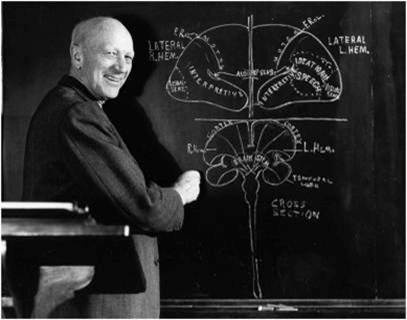
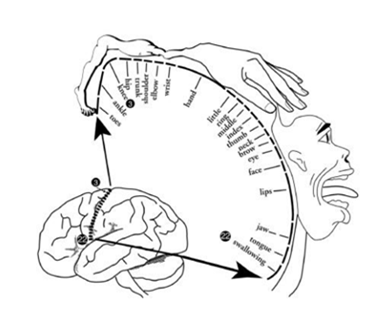
Left: Canadian neurosurgeon Wilder Penfield pictured with his blackboard drawings of the cerebral cortex (adapted from Ladino et al., 2018). Right: The somatosensory homunculus: a map of the human body as represented in the somatosensory cortex, where each body part is positioned and sized according to the amount of space the brain devotes to it (adapted from the Brainfacts handout from the Society for Neuroscience, 2014).
This brings us to headaches, which affect around half of all adults at least once a year. People often feel the pain from headaches in a very specific place: commonly behind the eyes, across the forehead, or at the back of the head. The brain itself does not have any pain or touch receptors. So if the brain itself cannot be hurtful, what is a “head ache”? The answer lies in the structures surrounding the brain: blood vessels, the meninges (the membranes wrapping the brain), and the muscles of the skull and neck. These structures do have pain receptors and can transmit that information to the brain, which then makes us feel as though the pain is located in a specific part of it.
A telling example of this is sinus headaches, which are felt at the front of the head. The sinuses are hollow, air-filled cavities sitting right behind the forehead and around the nose and eyes. They produce mucus to fight off bacteria and viruses, but can become infected, increasing pressure and causing pain. And because of where they sit, it can easily feel like the pain is coming from the brain itself. Headaches can also come from irritation of the meninges. This happens, for example, in meningitis, a serious condition in which bacteria or viruses cause these layers to become inflamed (the suffix “-itis” simply means inflammation).
A similar process occurs during a migraine. In this case, the trigeminal nerve (a major nerve responsible for sensation in the face) gets overactivated. The trigeminal nerve picks up pain signals from receptors in the meninges and blood vessels (again not from the brain itself). When it becomes too active, it releases inflammatory chemicals (neuropeptides). These chemicals travel into the brain and can amplify along the way, leading to the intense and persistent pain experienced during a migraine. As a result, people with migraines may perceive normally non-painful stimuli, such as lightly touching the head, as painful.
Conclusion
There’s an interesting paradox: although the brain is where pain is processed, the brain tissue itself cannot feel pain because it has no pain receptors. Instead, headache pain arises from surrounding structures, such as the meninges, which can detect and transmit pain signals to the brain itself.
Read more?
[Dutch] www.hoofdpijnonderzoek.nl or [English] www.headacheresearch.en or listen to the [Dutch] DE HOOFDPIJNPODCAST van het Leiden Universitair Medisch Centrum