

Short answer
There isn’t a single most important brain region! It all depends on what we define as important: does importance mean staying alive (i.e. the brain stem, which coordinates breathing and heart rate) or living well (i.e. the cerebral cortex, where our memories and cognition are stored)?
Longer answer
Ask yourself: What’s the most important part of an orchestra? Is it the violinists? The percussionists? The conductor? The answer to this question really depends on what you’re trying to do. We can think about the brain in a similar way. There isn’t a single most important region: it depends on what you mean by important.
Keeping you alive
If ‘most important’ means keeping you alive, then the answer is undoubtedly the brainstem. This part of the brain controls vital functions like breathing, heart rate, blood pressure, and arousal. You rarely think about it, but if it’s injured or stops working, everything else stops working too. Damage to the brainstem is often immediately life-threatening, so from a purely survival perspective, it might be considered the most critical region.
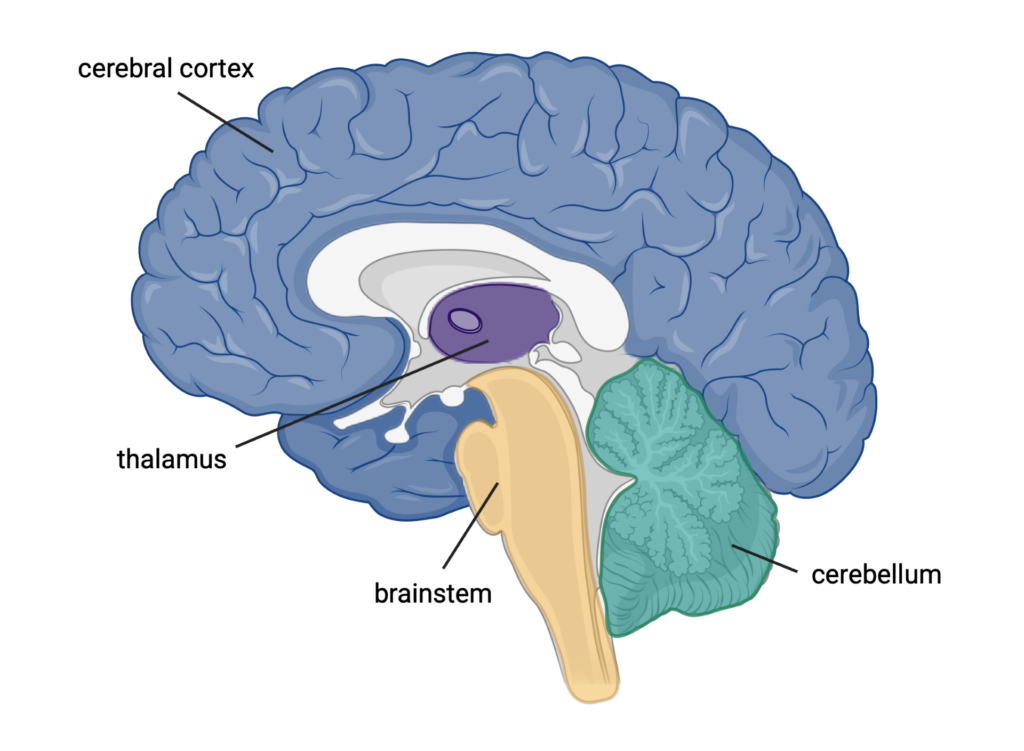
Figure 1: Diagram of major brain regions. Created in BioRender. Helmich, R. (2026) https://BioRender.com/6ua7xvy
Being fully human
If ‘most important’ means allowing you to be fully human and experiencing the world around you, then the answer to this question may shift to the cerebral cortex. This folded outer layer of the brain supports functions like thinking, planning, language, perception, and creativity, among many others. Cortical regions are not essential for keeping you alive, but they are arguably responsible for the processes that make life worth living. Through cortical regions we learn new ideas, socialize with our friends, make and enjoy art, and plan for our future. While you can technically survive without much of the cortex, whether you’ll thrive without it is another story…
Keeping everything in synchrony
Next to the cortex and brain stem, there are regions like the thalamus, which act like central relay stations to help different brain areas communicate effectively. Damage to these hub regions can have ripple effects, broadly disrupting perception, movement, or even consciousness.
Do different animals rely on different brain regions?
So far we have focused on brain areas that are important for humans. But perhaps other animals have different priorities, which are reflected in their brains? Brains come in many shapes and sizes (see also: ‘Are there people or animals with more or fewer than two brain hemispheres?’), and it is true that some brain areas are proportionally larger in certain species (the olfactory bulb in reptiles, for instance, or the cerebral cortex in humans), suggesting they may play a relatively larger role. But this does not mean those animals can do without the other brain areas. Every animal needs all of its brain regions working together, and when you look closely, the similarities across species outweigh the differences (see also: ‘Do we really have a reptile brain, a mammal brain, and a human brain inside our heads?’ – to be published). So perhaps asking which brain areas are most important is not quite the right question, for humans but neither for any other animal.
Conclusion
Instead of asking which brain region is most important, a better question is: important for what? Even better is to think of the brain not as a set of independent parts with distinct roles, but a complex, coordinated network of interacting regions that each serve an important role. In this sense, the brain is like an orchestra, where individual musicians work together to play a symphony.