

Short answer
Yes, there are people living with less than two brain hemispheres. And in animals, sometimes you can’t even talk about “hemispheres” or even “brains” at all. Nervous systems come in many shapes and sizes: from the classic two-part brain in mammals to chains of ganglia (nerve cell clusters) in animals like leeches and snails. Some animals, such as octopuses, even have partly independent nervous systems in their limbs. In humans, brains are hardly ‘one size fits all’ either. For example, some people live with just one hemisphere after surgery for severe epilepsy.
Longer answer
The brain as you (think you) know it
The nervous system as you know it can roughly be divided into four parts: a central control point (the brain), the brainstem, the spinal cord, and the nerves that branch out from them. The brain, generally known as the central control center (is that true for every animal? Keep reading to find out!), is a large wrinkled mass further divided into two halves.
Not only the human brain is symmetrically divided, all mammals, fish, birds, and reptiles follow a similar two-sided subdivision. Of course, that doesn’t mean humans and fish have the same brain! There’s an incredible amount of variation among all these animals and how their brains look. The size, shape (elongated or round), and the folding of the brain differs greatly between species. However, one thing all these brains have in common is that they consist of two halves.
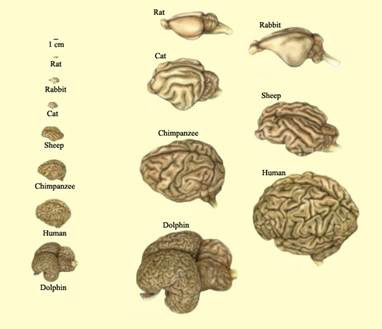
Figure 1: Brains of different mammals. Does this mean dolphins are smarter than we are? See: https://brainhelpdesk.nl/vraag/hoe-zwaar-was-einsteins-brein-zegt-de-grootte-van-je-hersenen-iets-over-intelligentie/
Ganglia: strings of connected mini-brains?
The nervous systems of the animal kingdom are extremely diverse, not only in size or shape. The way all those nerve cells are distributed within the nervous system also differs per species. Mammals, fish, birds, and reptiles all have a clear central nervous system and a peripheral nervous system.
The central nervous system consists of the brain (split in two hemispheres), the brainstem, and the spinal cord. While the peripheral nervous system consists of the nerves that branch out from the brainstem and spinal cord. These nerves are essential for controlling muscles and glands and for enabling sensory functions. Within the peripheral nervous system, there are small clusters of nerve cells that act as relay points between the central system and the periphery. These clusters of nerve cells are called ganglia.
In humans and most other animals, these ganglia are small structures that make up only a tiny percentage of the total nervous system. What is fascinating, is that there are certain species where a chain of ganglia makes up the entire nervous system! These animals therefore don’t have the two brain hemispheres we’re used to, but rather a chain of “mini-brains.”
Brains in many shapes and sizes
Take the leech, for example, a creature you’d rather not meet up close, but one that has an incredibly interesting nervous system! The leech has 32 ganglia distributed throughout its body, from which nerves branch out into the rest of the body. This way, their nervous system is spread across the body without a clearly defined central hub through which all information passes.
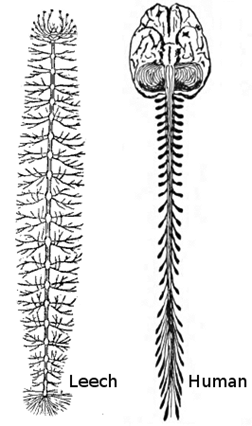
Figure 2: Nervous system of a leech (left) and a human (right). The leech’s nervous system consists of connected nerve knots, while the human nervous system has a centralized control point (the brain, located at the top of the image) connected to the spinal cord.
Mollusks such as snails, octopuses, and oysters have a similar nervous system divided into ganglia. A snail, for instance, has about six ganglia that together form its nervous system. Octopuses, however, differ from snails and leeches because they do have one centralized ganglion. Fun fact: From this central ganglion extend the largest nerve cells found in any animal. In the 1950s, researchers Alan Lloyd Hodgkin and Andrew Fielding Huxley were the first ever to measure an electrical signal in these giant cells, which won them the Nobel prize!
The octopus, a relative of the squid, also has a complex and fascinating nervous system. It possesses a centralized system of about 150 million neurons forming a network that connects the rest of the body, especially the arms. Each arm has a semi-independent network of another 40 million neurons. These arms can receive, process, and act on sensory information without going through the central brain.
Imagine if each of your limbs had its own little nervous system, unthinkable! Just like the octopus, some land animals such as certain small spiders have many extra ganglia in their legs. In fact, some spiders have up to 25% of their entire nervous system located in their legs! Not too surprising, considering how good they are at weaving intricate webs.
All in all, there is an incredible amount of different brains, and there is no golden standard for how brains have evolved. Studying how different brains work not only helps us understand the world around us, but also teaches us more about our own nervous system.
Are there people with only one brain hemisphere?
The human brain also differs from person to person! Although a lot less drastically than differences between animal species. One thing is clear: it always has that same two-part division… right? Well, not entirely! There are conditions where one hemisphere is larger than the other, or where the two halves don’t connect properly. In these cases, however, there are still two hemispheres present.
There is, however, one situation in which people live with only a single hemisphere, in severe epilepsy for example. Severe epilepsy is characterized by intense seizures that can make daily functioning very difficult. In extreme cases, a surgical procedure may be performed where one hemisphere is removed. This prevents the epileptic activity, which originates in one hemisphere, from spreading throughout the entire brain.
Amazingly, thanks to the brain’s incredible adaptability and good rehabilitation, these patients often live seizure-free lives and generally enjoy a much better quality of life than before surgery.
Further reading
[English] https://www.si.edu/newsdesk/releases/whole-new-meaning-thinking-your-feet
[English] https://www.newscientist.com/article/dn20925-brainy-molluscs-evolved-nervous-systems-four-times/
[English] https://www.scientificamerican.com/article/how-octopus-arms-bypass-the-brain/rain/