

Short answer
Yes, we continue to produce new brain cells throughout our lives.
Longer answer
Discovery of new brain cells in the adult brain
It has long been assumed that the birth and formation of new nerve cells occurred only during early brain development and that, once the brain had reached maturity, all cell division and formation ceased permanently. This proved to be incorrect. Using specialized techniques, researchers were able to demonstrate the formation of new brain cells in adulthood, particularly in two brain regions: one involved in the sense of smell and another involved in memory (the hippocampus). This generation of new brain cells in adulthood is known as ‘adult neurogenesis.’ Following its discovery, the phenomenon was extensively studied in laboratory animals, revealing that the process is influenced by environmental factors; for instance, neurogenesis is suppressed by stress—particularly stress experienced early in life—whereas it is stimulated by physical exercise or housing in an enriched environment.
Are the new brain cells working?
The newly born nerve cells do not only appear, they ‘join in’ as well; after a few weeks, they become electrically active and functional and are integrated into the existing hippocampal network, where they play a key role in anxiety, cognition in general, and learning and memory in particular. Neurogenesis is essential, especially for distinguishing between events that are very similar in terms of time and place (‘pattern separation’). Furthermore, neurogenesis is altered in (animal models of) brain disorders such as depression, epilepsy, and dementia.
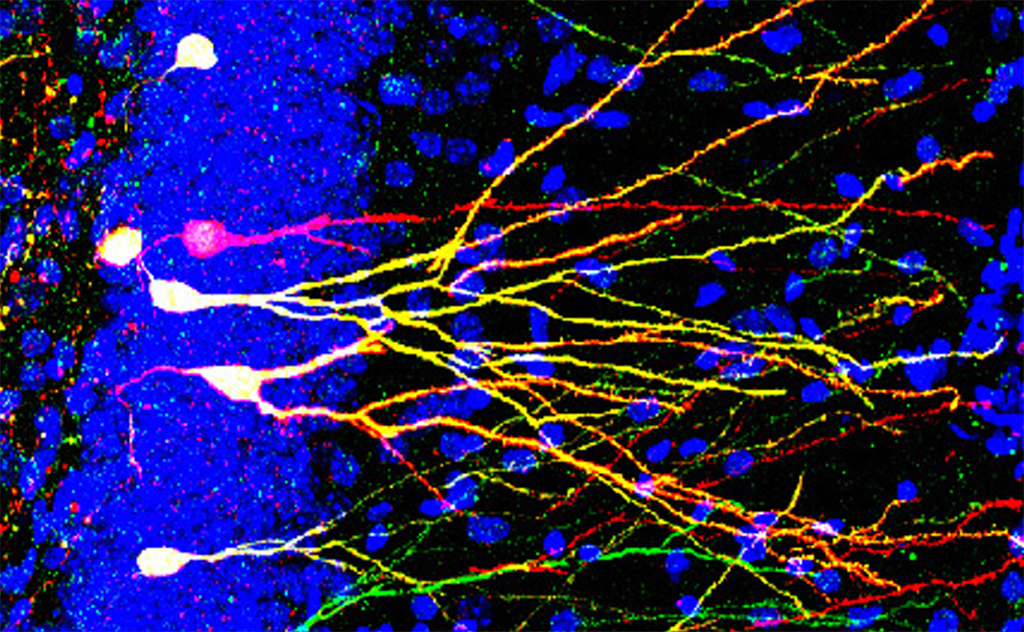
Figure 1: Newborn cells (in white) amidst the (blue) adult nerve cells in the hippocampus of an adult rat. Source: Paul Lucassen’s research group
Has it also been shown in humans?
A major question has been whether neurogenesis also occurs in the human brain. It has recently been convincingly demonstrated that neurogenesis does indeed occur in human brain tissue, across the entire age spectrum. While a gradual decline in the level of neurogenesis is observed with advancing age, the formation of new neurons is still found even in old age.
Relationship with brain diseases
In patients with Alzheimer’s disease, the age-related decline in neurogenesis is much more pronounced and begins at an earlier age. Interestingly, individuals who reach an advanced age—so-called “super-agers”—appear to maintain relatively high levels of neurogenesis. Similarly, patients who show evidence of Alzheimer’s pathology in the brain yet exhibit little to no symptoms—known as “resilient individuals”—also display high levels of neurogenesis. Thus, neurogenesis appears to have a protective effect. This suggests that neurogenesis may play a key role in resisting cognitive decline and brain aging—an area that offers numerous avenues for further research.
Read more?
- Neurogenese in humans:
- In patients with Alzheimer’s disease, the age-related decline in neurogenesis is much more pronounced and begins at an earlier age.
- More neurogenesis in super-agers: Disouky 2026
- Protective effect of neurogenesis Tosoni 2026
- Vervolgonderzoek naar neurogenese: Doludda 2026
- BrainHelpDesk articles about Alzheimer: